May 15, 2026 • Extuent • Finance & Accounting
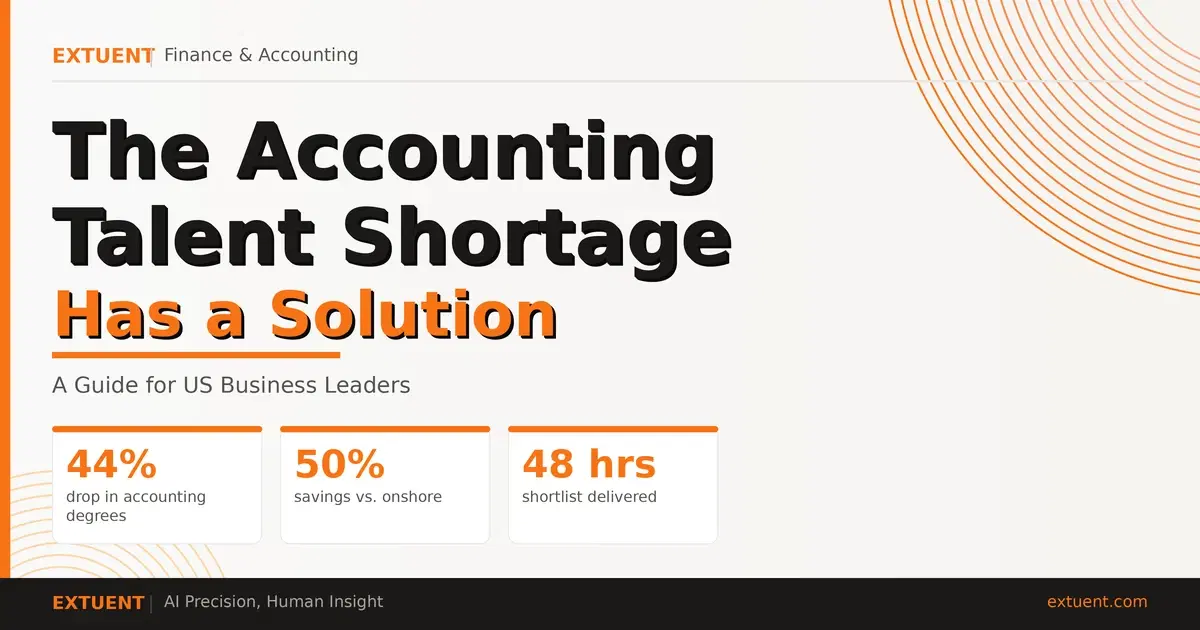
If you are a CFO or Finance Director at a mid-market company, you have probably felt it: the accounting talent shortage is not a future problem. It is happening right now, on your balance sheet. Open headcount in AP, staff accounting, and FP&A departments is dragging close timelines, stressing existing staff, and forcing expensive overtime. Local recruiting pipelines that worked five years ago are delivering fewer qualified candidates at higher salary expectations — and the trend is not reversing. The numbers behind the accounting talent shortage are stark. The number of accounting degrees awarded in the US has declined 44% since 2010. The AICPA estimates that more than 75% of currently licensed CPAs are approaching retirement age. Meanwhile, the Bureau of Labor Statistics projects demand for accounting and finance roles will continue to grow through the end of the decade. The math does not add up — and mid-market companies, competing for the same diminished talent pool as Fortune 500 firms, are the ones feeling the squeeze most acutely. The good news: forward-thinking finance leaders are solving this problem not by competing harder for local talent, but by building remote finance teams with pre-vetted, top-tier professionals from global talent markets.
For decades, the playbook was simple: post the role, screen résumés, interview, hire. That process assumed a reasonably deep talent pool. Today, that assumption no longer holds. Accounts payable specialists, staff accountants, and FP&A analysts are in short supply across nearly every US market. Recruiters report time-to-fill for mid-level finance roles stretching to 90 days or more in competitive metros. When candidates are found, salary expectations have jumped 20–30% above pre-2022 benchmarks — driven by inflation, remote work optionality, and competition from larger enterprises with deeper pockets. For mid-market companies in the 100–5,000 employee range, this creates a particularly painful bind. You need the same finance functions as a large enterprise — accurate AP management, rigorous financial reporting, real-time FP&A — but you are competing for talent with companies that can outspend you on compensation, signing bonuses, and brand recognition. The answer is not to keep running the same play and expect different results. The accounting talent shortage demands a structural response: expanding your hiring geography while maintaining the quality standards your finance function requires.
Remote staffing for finance functions has matured significantly. This is not the offshore outsourcing of the early 2000s, characterised by language barriers, timezone misalignment, and quality inconsistency. Today's top-tier remote finance professionals — particularly those from India and the Philippines — are trained in US GAAP, proficient in leading ERP systems (SAP, NetSuite, QuickBooks, Oracle), and available in timezone-aligned or overlapping working hours. When a mid-market company builds a remote accounting team through a structured remote staffing platform, it gains dedicated professionals who function as direct extensions of the internal team. These are not shared resources or rotating contractors. They are your accounts payable specialists, your staff accountants, your FP&A analysts — hired for your company, onboarded to your processes, and accountable to your finance leadership. Roles that are particularly well-suited to remote delivery include accounts payable, accounts receivable, bank reconciliation, month-end close support, management reporting, financial modelling, and compliance administration. For companies operating in regulated industries — healthcare, cannabis, financial services — remote finance staff have demonstrated strong proficiency in SOX compliance, internal controls documentation, and audit preparation. The key shift in 2026 is AI-assisted vetting, which has raised the quality floor substantially. The top 3% of available global finance talent can now be identified with precision, tested for technical proficiency, and assessed for communication quality and cultural fit — before you ever speak with a candidate.
One of the most common objections finance leaders raise about remote staffing is quality assurance. How do you know the candidate you are hiring is genuinely capable — not just interview-ready? This is where AI-driven vetting platforms have changed the game. Rather than relying on résumé screening and a single interview, modern remote staffing providers use multi-stage assessment frameworks that include technical skills testing (accounting software proficiency, scenario-based finance problems), one-way video interviews reviewed for communication clarity and professional presentation, and AI scoring that benchmarks candidates against thousands of similar role profiles. At Extuent, every candidate in the talent network of 30,000+ professionals has been assessed across these dimensions before being presented to a client. When a shortlist reaches a CFO or Finance Director, every individual on that list has already cleared a high bar. The live interview — which the client conducts on their own terms — becomes a final culture and fit confirmation, not a broad quality filter. This approach compresses hiring timelines dramatically. Extuent delivers an initial shortlist within 48 hours of a discovery session — including pricing, availability, video interview recordings, and AI assessment scores. Compare that to 90-day local recruiting cycles, and the operational advantage becomes clear.
Finance leaders are number people. So let us talk numbers directly. A mid-market company hiring a US-based staff accountant in a major metro market in 2026 can expect to pay $80,000–$110,000 in base salary, plus benefits, employer taxes, and recruiting fees that bring total cost of hire to $120,000–$140,000 or more per year, per seat. A comparable, AI-vetted remote staff accountant — with equivalent qualifications, ERP proficiency, and English communication skills — costs significantly less when hired through a structured global staffing platform. Extuent clients consistently report annualised savings of up to 50% versus onshore equivalents, without compromising on output quality or requiring a reduction in scope. Across a finance team of five to ten people, that savings compounds quickly. A ten-person remote finance team generating 40% cost savings versus onshore equivalents represents hundreds of thousands of dollars in annualised savings — capital that can be redeployed into growth initiatives, technology investments, or margin improvement. It is also worth noting that total cost of ownership for a remote finance team is lower beyond just salary. Office space, equipment provisioning, and domestic benefits administration are either reduced or eliminated. The staffing provider typically manages payroll infrastructure, compliance, and HR administration for remote staff.
The accounting talent shortage is not hypothetical for Extuent clients — and neither are the results of solving it through remote staffing. An auto lending company based in Texas was struggling to attract collections and finance talent locally, with margin pressure from persistent inflation compounding the hiring problem. Extuent built an eight-person remote collections team, sourced from the Philippines, in 14 days. In the first month, the company saw a 40% increase in dollars collected, a 30% improvement in service levels, and more than $500,000 in annualised cost savings. A wellness company in Florida with 2,500 employees faced a multi-function talent gap spanning finance, IT, HR, training, SOX compliance, and pricing. Extuent deployed an 18-member remote team from the Philippines and India in 30 days, delivering more than $1.25 million in annualised savings alongside measurable improvements in output quality. A car wash company operating 75+ locations across Tennessee needed to fill customer service, finance, and HR roles that were proving impossible to hire locally. An Extuent-built 10-person remote team was operational in 14 days, delivering $750,000 in annualised savings and enhanced service levels across the business. These are not edge cases. They are the consistent pattern when mid-market companies make a deliberate, structured decision to solve the [accounting talent shortage](/teams/finance-accounting) through remote staffing rather than waiting for local conditions to improve.
For CFOs considering remote finance staffing for the first time, the process is more straightforward than most expect — particularly when working with a provider that handles vetting, onboarding, and HR infrastructure. The typical journey at Extuent begins with a discovery session: a structured conversation where a client success manager maps the company's people, process, and technology requirements in detail. From that session, the 48-hour shortlist is built — with candidates matched not just on technical skills but on team dynamics, communication style, and cultural alignment with the hiring company. Once a client selects their candidate, Extuent manages all onboarding logistics. Remote team members are typically operational within 14 to 30 days of selection. Ongoing support, performance management frameworks, and regular check-ins ensure the team integrates effectively and delivers against the finance function's expectations. The result is a scalable, high-quality remote finance team that functions as a genuine extension of your internal organisation — not a vendor relationship, but a team-building partnership.
The accounting talent shortage is a structural challenge, and it will not resolve itself in the near term. CFOs and Finance Directors who continue waiting for local talent markets to improve are leaving performance on the table — and handing competitive advantage to peers who have already made the shift. Remote staffing, anchored by rigorous AI-driven vetting and a transparent partnership model, is how mid-market finance leaders are solving this problem today. The talent exists. The technology to identify it accurately exists. The operational frameworks to integrate it effectively exist. The only thing left is the decision to act. If your finance team has open headcount, stretched capacity, or rising cost pressure, now is the time to explore what a purpose-built remote accounting team could deliver for your business. [Contact Extuent today](/contact) to schedule a discovery session and receive your first shortlist within 48 hours.
Extuent connects mid-market US companies with AI-vetted, top 3% finance professionals from India and the Philippines — delivered as a tailored shortlist within 48 hours. Every candidate is pre-screened for technical proficiency, ERP experience, and English communication, so your finance leadership can focus on selection, not sourcing.
The accounting talent shortage is a structural challenge, and it will not resolve itself in the near term. CFOs and Finance Directors who continue waiting for local talent markets to improve are leaving performance on the table. Remote staffing, anchored by rigorous AI-driven vetting and a transparent partnership model, is how mid-market finance leaders are solving this problem today. If your finance team has open headcount, stretched capacity, or rising cost pressure, now is the time to act. Contact Extuent today to schedule a discovery session and receive your first shortlist within 48 hours.
