May 27, 2026 • Extuent • Finance & Accounting
Ask any mid-market CFO in 2026 what is holding their finance organization back, and the answer is almost never strategy — it is capacity. Forecasts run monthly when they should run weekly. Variance analysis lands late. The scenario models the board is asking for sit in a backlog. The instinctive response is to hire another senior analyst, but the math has stopped working: fully-loaded onshore FP&A costs have climbed past $130,000, talent is scarce, and tenure is short. A growing number of CFOs are taking a different path — building a remote FP&A team that extends analytical capacity without inflating headcount cost. Here is what that model looks like, and why the economics are fundamentally different from the onshore-only finance organization most mid-market companies still run.
Most finance leaders assume the accounting talent shortage applies equally across every finance role — it does not. Transactional roles like accounts payable and bookkeeping are tight, but the deepest and most damaging gap in 2026 is in financial planning and analysis. The skill set is rarer — strong FP&A analysts combine accounting fluency with modeling, business partnering, and increasingly, dashboard and BI tool expertise — and demand has expanded rapidly as boards and PE sponsors push mid-market companies toward more rigorous forecasting and scenario planning. The numbers tell the story. Fully-loaded onshore FP&A analyst costs in the United States now range from $110,000 to $160,000 once benefits, payroll taxes, equipment, and recruiting amortization are factored in. Senior analysts and FP&A managers run materially higher. Average time-to-fill for a qualified mid-market FP&A role sits between 90 and 130 days, and once filled, average tenure in the role is just over two years. For a CFO trying to build a sustainable analytics function, the implication is uncomfortable: the role you are trying to hire for is one of the hardest, slowest, and most expensive to fill in your entire finance organization — and you are likely to need to do it again sooner than expected.
The FP&A talent shortage is not abstract — it shows up as concrete work that does not get done, or gets done late by senior leaders whose time is worth significantly more. A typical mid-market FP&A function in 2026 is responsible for the annual operating plan, monthly and quarterly forecast cycles, variance analysis and management reporting, board and lender packages, scenario and sensitivity modeling, capital expenditure analysis, pricing and unit economics work, BI and dashboard maintenance, and ad-hoc analytical support for the CEO and operating teams. Most mid-market finance organizations are trying to deliver that scope with two or three onshore analysts and a manager. That is structurally insufficient. When one analyst goes on PTO, the close slows down. When the board asks for a scenario model with a 48-hour turnaround, something else gets dropped. The work that loses out is almost always the strategic, forward-looking analysis — exactly the work that finance is supposed to lead. The result is a finance organization that spends 80% of its time in the rear-view mirror and 20% on the road ahead, when the ratio should be reversed. A remote FP&A team built correctly does not replace the senior analysts and FP&A leaders who own business partnering and executive presentation. It extends them. Repetitive model maintenance, data refreshes, variance commentary, dashboard updates, board package assembly, and the first pass on scenario builds are exactly the kind of high-value but structured work that can be reliably delivered by experienced offshore analysts — freeing the onshore team to focus on judgment-intensive work.
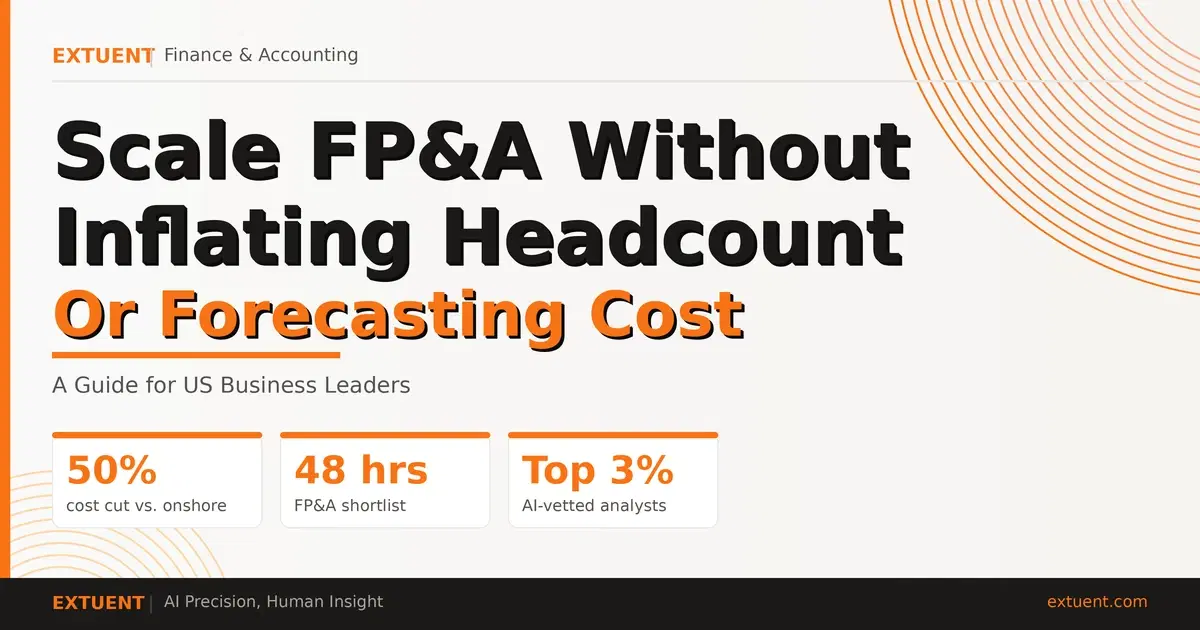
The cost differential between an onshore and a remote FP&A analyst is significant enough to change the strategic question — not just the budget line. A fully-loaded FP&A analyst on a dedicated remote team from India or the Philippines typically costs 45% to 55% less than the equivalent onshore hire, with mid-level analysts landing in the $45,000 to $60,000 range fully-loaded and senior analysts running $60,000 to $85,000. For a CFO who would otherwise hire one onshore senior analyst at $145,000, the same budget supports two senior remote analysts plus a mid-level — roughly tripling analytical capacity for the same spend. The candidate quality available at those numbers is the part that surprises most CFOs. India is the global hub for finance and accounting outsourcing, with deep talent pools that have served Big Four firms and Fortune 500 captives for decades. The Philippines has built a parallel strength in financial planning and FP&A modeling, with strong business communication and US accounting fluency. A well-vetted shortlist will routinely include analysts with five to ten years of FP&A experience, CFA progression, advanced Excel and Power BI capability, and direct exposure to NetSuite, Workday Adaptive Planning, or Anaplan. Retention is the third lever. Attrition rates on dedicated remote FP&A teams in India and the Philippines typically run 12% to 18% annually, compared to the 25% to 30% rolling turnover that is now common in US onshore FP&A roles. A tenured analyst who knows your chart of accounts, your driver model, and your board package format is structurally more productive than a constantly-rotating onshore one — even before you account for the cost differential.
Many mid-market CFOs first try to plug the FP&A capacity gap with a consulting firm or a fractional CFO arrangement. That approach has a place, but it is rarely the right solution for ongoing FP&A work. Consulting engagements are expensive, time-limited, and structured around discrete projects — useful when you need a one-time profitability study or a transaction model, much less useful when what you actually need is consistent, weekly analytical horsepower against a recurring forecast cycle. A dedicated remote FP&A analyst is fundamentally different from a consultant. They are hired for your company, embedded in your team rituals, reporting into your FP&A leadership, working from your financial systems, and accumulating institutional knowledge over time. They join your forecast calls. They learn your business drivers. They develop a point of view on which line items are noisy and which are signal. The relationship looks and feels like an in-house analyst, because functionally that is what it is — at roughly half the fully-loaded cost. This distinction matters in FP&A more than almost any other finance function. FP&A quality is overwhelmingly driven by familiarity with the business: the model architecture, the operating drivers, the history of forecast misses and what caused them, the personalities of the leaders being supported. None of that is recoverable in a project-based engagement. All of it compounds inside a dedicated remote team that stays in place for years.
The model is not theoretical. A Florida-based wellness company with 2,500 employees was facing a multi-function talent gap that included FP&A, pricing analysis, SOX compliance, and broader finance and HR work. Within 30 days, an 18-person remote team from the Philippines and India was operational across the full scope. The result was $1.25M in annualized savings, improved service levels across every covered function, and a measurable lift in analytical output — including a finally-functioning monthly forecast and a redesigned board package that the CFO had been trying to deliver for over a year. A Florida alternative medicine company faced a smaller-scale version of the same problem: finance, IT, HR, and compliance functions that were structurally understaffed and impossible to fill onshore. A seven-member remote team from India and the Philippines went live in 14 days, delivering over $450,000 in annualized savings while building a foundation for longer-term analytical work. The finance and FP&A portion of the team produced the most immediate strategic impact — taking management reporting and variance analysis off the senior controller's plate so the controller could focus on integration work. Read more in Extuent's [client case studies](/case-studies) for a full breakdown of results across sectors and functions.
Building a remote FP&A function is not the same as posting a job and hoping. The CFOs who succeed with this model treat the build with the same rigor they would apply to an internal hire — with one structural advantage: a well-vetted staffing partner shortens the calendar dramatically. The questions worth asking a prospective partner are concrete. How is analytical aptitude assessed beyond a CV — are candidates actually tested on modeling, accounting fluency, and business judgment? What does the communication and English-language business writing screen look like? How long does deployment realistically take from kickoff to a live, productive analyst? And what is the partner's track record with mid-market US finance organizations specifically — not enterprise captives, not startups? At Extuent, FP&A candidates are vetted through AI-powered assessments and structured one-way video interviews before being shortlisted. By the time a CFO reviews a slate of five or six analysts, each has already been scored on technical aptitude, communication, and culture fit — so the shortlist is genuinely the top 3%, not a long list filtered for availability. The typical timeline from discovery session to an operational analyst or team is 14 to 30 days, with the initial shortlist delivered within 48 hours of kickoff. Learn more about how Extuent builds [Finance & Accounting teams](/teams/finance-accounting) for mid-market US businesses.
Extuent connects US mid-market CFOs with pre-screened, top 3% FP&A analysts and finance professionals from India and the Philippines — delivering a fully vetted shortlist within 48 hours and an operational team in as little as 14 days. Our AI-powered vetting model gives finance leaders dedicated analytical capacity at roughly half the fully-loaded cost of comparable onshore hires.
For mid-market CFOs in 2026, the math of staffing FP&A entirely onshore has stopped working. Salaries have climbed faster than budgets. Time-to-fill is measured in quarters, not weeks. And the analytical work that should be driving the business forward is being delivered by people whose time would be better spent on judgment, not data wrangling. A dedicated remote FP&A team is not a cost-cutting shortcut — it is a more durable, more scalable, and more strategically aligned way to deliver the forecasting, modeling, and analysis a mid-market finance organization is actually responsible for. If your FP&A function is delivering the rear-view mirror but not the road ahead, it is worth understanding what a different staffing model could look like. Contact Extuent today to schedule a discovery session and receive a shortlist of pre-vetted FP&A analysts within 48 hours.
