May 25, 2026 • Extuent • IT Services
Walk into the office of almost any mid-market CIO or IT Director in 2026 and you will hear a version of the same story. Ticket volumes are rising. End users expect always-on support across multiple time zones and devices. Cybersecurity demands have pushed compliance work onto already-stretched teams. And the cost of building a full IT support function onshore — between rising salaries, recruiting fees, attrition, and benefits — has climbed faster than most IT budgets can absorb. The traditional response was to either accept slower service levels or push for headcount approvals that rarely come. A growing number of mid-market IT leaders are taking a different path: building a dedicated remote IT support team that delivers higher service levels at a significantly lower cost. Here is why that model is gaining traction, and what the math actually looks like.
Most finance and IT leaders intuitively know that running an onshore help desk is expensive. Fewer have calculated what it actually costs per resolved ticket — and the number is sobering. Industry benchmarks for 2026 put the fully-loaded cost of an onshore IT support hire between $60,000 and $80,000, with an additional $15,000 in recruiting and onboarding before the first ticket is resolved. Once that agent is productive, labor typically accounts for 60% to 80% of total help desk spend, with technology, infrastructure, and overhead consuming the rest. The cost per ticket numbers are equally striking. SaaS-style support averages between $18 and $35 per ticket, while B2B and internal IT support — which usually involves deeper troubleshooting, hardware coordination, and escalations — runs $30 to $60 per ticket in onshore environments. For a mid-market business processing 8,000 to 15,000 internal IT tickets per year, that translates to a help desk operating cost of $300,000 to $900,000 annually — and that is before you account for the cost of the management layer, the after-hours premium, and the productivity loss every time a help desk position turns over.
A decade ago, only large enterprises needed round-the-clock IT support. In 2026, that is no longer true. Hybrid and remote work has spread end users across time zones. SaaS-driven business models mean that an outage at 2 a.m. is no longer just an inconvenience — it can take down customer-facing functions, revenue systems, or regulated workflows. Security incidents do not respect business hours, and increasingly, neither do the auditors and insurers who expect documented response procedures. Building 24/7 coverage onshore is mathematically punishing. A truly 24/7 help desk requires roughly four full-time agents per coverage slot once you account for shift coverage, weekends, vacation, and holidays. For a small support function that needs three concurrent agents, that is twelve full-time hires — and night-shift premiums add another 15% to 25% on top of base salary. A remote IT support team distributed across the Philippines and India solves this structurally rather than financially. The time zones are naturally complementary to US business hours, which means a follow-the-sun coverage model is achievable without paying anyone a night-shift premium.
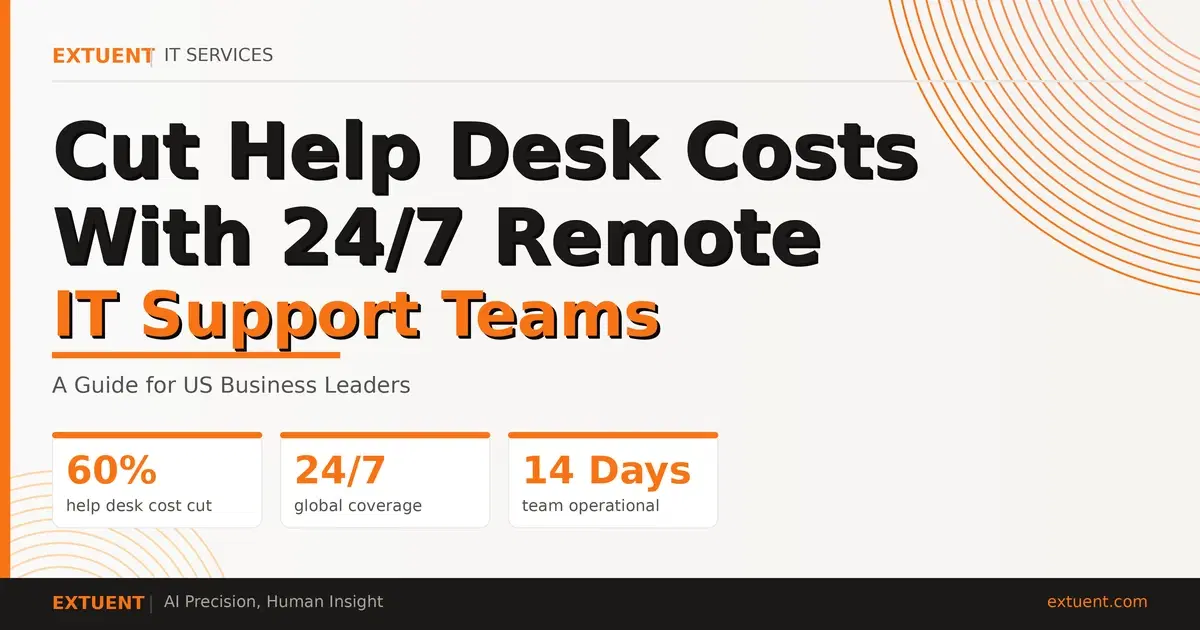
The cost differential between onshore and dedicated remote IT support is large enough to change strategic decisions, not just line items. A fully-loaded IT support specialist on a dedicated remote team from the Philippines or India typically costs 50% to 60% less than the equivalent onshore hire — across salary, benefits, employer taxes, infrastructure, and management overhead. For a 10-person internal IT support function, that translates to annualized savings between $400,000 and $700,000, depending on role mix and seniority. But the cost story is only part of the value. The talent pool itself is structurally favorable. India is the world's largest market for IT services labor, and the Philippines has built a deep bench of certified IT support and infrastructure specialists serving Western clients. The candidates available to a well-vetted dedicated remote team — engineers with CompTIA, Microsoft, Cisco, AWS, and ITIL certifications, often with five to ten years of experience supporting US-based enterprises — are frequently more senior than what mid-market US companies can attract at similar fully-loaded costs locally. Retention is the other lever. Attrition rates on dedicated remote IT support teams in India and the Philippines typically run between 10% and 18% annually, well below the 25% to 35% turnover that is common in US onshore IT support roles.
In conversations with mid-market IT leaders, one objection comes up repeatedly: 'We tried outsourcing once, it didn't work.' Almost without exception, what they tried was a traditional BPO arrangement — buying ticket-hours from a shared pool of agents working across multiple clients. That model has a place, but it is not the right fit for an internal IT support function where context, security access, and brand fluency matter. A dedicated remote IT support team is fundamentally different. These are individuals hired for your company, reporting into your IT leadership, working from your ticketing system, and learning your environment over time. They show up to your standup. They participate in your change management process. They know which VP is allowed to skip the security training reminder and which one is not. The relationship looks and feels like an extension of your internal team, because functionally that is what it is. This distinction matters enormously for IT specifically. Help desk effectiveness is overwhelmingly driven by familiarity — with the user base, the tooling, the historical incident patterns, and the cultural expectations around how IT communicates internally.
The outcomes from this model are not theoretical. A Florida-based wellness company with 2,500 employees was facing a multi-function talent gap across IT, finance, HR, training, SOX compliance, and pricing. Within 30 days, an 18-person remote team from the Philippines and India was operational, covering all six functions. The result was $1.25M in annualized savings, improved service levels, and a measurable lift in work quality compared to the previous mix of onshore staff and contract labor. A Florida alternative medicine company faced a similar problem at smaller scale: difficulty staffing IT, finance, HR, training, and compliance functions onshore. A seven-member remote team from the Philippines and India went live within 14 days, delivering over $450,000 in annualized savings while building a foundation for longer-term growth. In both cases, the IT portion of the team delivered the most immediate operational impact — because IT support is the function most directly affected by the cost-per-ticket and 24/7 coverage dynamics described above.
Not every remote IT staffing provider delivers the same outcomes. The difference between a partnership that scales and one that frustrates everyone usually comes down to how rigorously the provider vets candidates before they ever reach your inbox. The questions worth asking are concrete. How is technical aptitude assessed beyond a CV — are candidates actually tested? What does the communication and language screen look like? How long does deployment realistically take from kickoff to a live, productive team? And what is the provider's experience working with mid-market US companies in your industry — not just enterprises or startups? At Extuent, IT support candidates are vetted through AI-powered assessments and structured one-way video interviews before being shortlisted. By the time a client reviews five or six candidates, each has already been scored on technical aptitude, communication, and culture fit — so the shortlist is genuinely the top 3%, not a long list filtered to the most available. The typical timeline from discovery session to a fully operational team is 14 to 30 days, with the initial shortlist delivered within 48 hours of kickoff.
Extuent connects US mid-market companies with pre-screened, top 3% IT support and infrastructure professionals from the Philippines and India — delivering a fully vetted shortlist within 48 hours and an operational team in as little as 14 days. Our AI-powered vetting process and dedicated staffing model help IT leaders cut help desk costs while extending coverage to 24/7 without onshore night-shift premiums.
For mid-market IT leaders in 2026, the math of running an entirely onshore help desk has stopped working. Costs are rising, attrition is structural, and the operational demand for 24/7 coverage is not going away. A dedicated remote IT support team is not a cost-cutting shortcut — it is a more durable, more scalable, and more capable model for delivering the IT support that mid-market businesses actually need. If your IT function is absorbing the cost of slow ticket resolution, gaps in overnight coverage, or relentless onshore attrition, it is worth understanding what a different staffing model could look like. Contact Extuent today to schedule a discovery session and receive a shortlist of pre-vetted IT support professionals within 48 hours.
